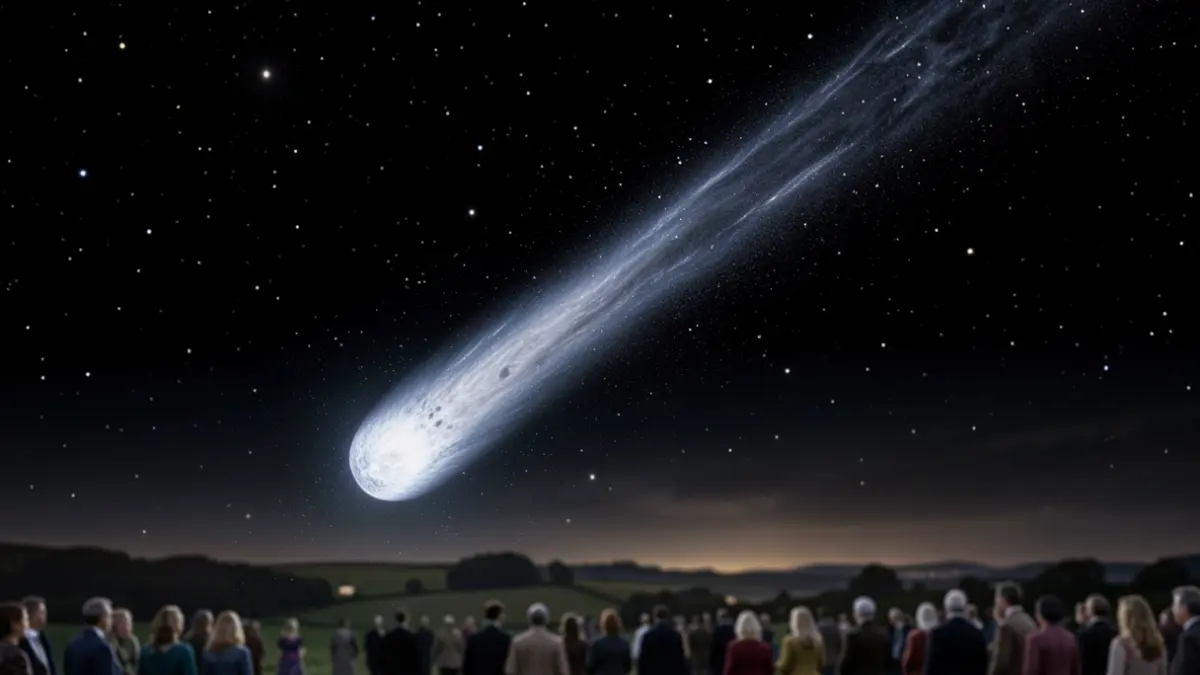
The idea that comets seeded life on Earth, a theory held for a century, is questioned by a new study led by researchers at the University of Cambridge. While comets are known to contain essential molecules, the study suggests their delivery to Earth was highly improbable.
Using computer modelling, the researchers determined that comets travel too fast and at too steep an angle to survive atmospheric entry and impact, likely vaporising fragile organic molecules. The study, published in Scientific Reports, also noted that Mars might be a slightly more plausible, though still unlikely, candidate for cometary delivery of prebiotic molecules.
Dr. Richard Anslow from Cambridge’s Institute of Astronomy, lead author of the study, explained that the romantic notion of comets acting as a 'get out of jail free card' for life's origins is unlikely. "Our results suggest it’s highly unlikely," he stated.
Building on previous work theorising that comets could deliver molecules by 'bouncing' between planets in closely orbiting systems, this latest research investigated such a scenario within our own Solar System. Advances in comet impact simulations and atmospheric interactions were used to analyse the likelihood of successful delivery.
The study focused on hydrogen cyanide (HCN), a key prebiotic molecule found on comets. Simulations indicated that even if HCN survived impact, the chances of delivering a useful concentration were extremely uncommon, especially as comet impacts declined rapidly in Earth's early history. "It would really have to be a one-in-a-million occurrence," Dr. Anslow commented, describing it as "at best, a one-off fluke."
The researchers suggest alternative sources for life's molecular seeds, including synthesis following asteroid impacts or processes occurring on Earth itself. While cometary delivery to Earth appears unlikely, Mars's thinner atmosphere and smaller size might have made it a more receptive target during the Solar System's early development.
These findings could aid future searches for extraterrestrial life, particularly with upcoming telescopes like the Habitable Worlds Observatory. Identifying systems with 'bouncing' comets could help astronomers narrow their search parameters.
The research received support from the Royal Society, the Leverhulme Centre for Life in the Universe, and the Science and Technology Facilities Council (STFC).