Women Scientists Largely Absent from UK Exam Boards, Cambridge Study Finds
New research highlights a significant gender imbalance in science education materials, potentially impacting girls' choices in STEM careers.
By Rebecca Flint
••3 min read
AI
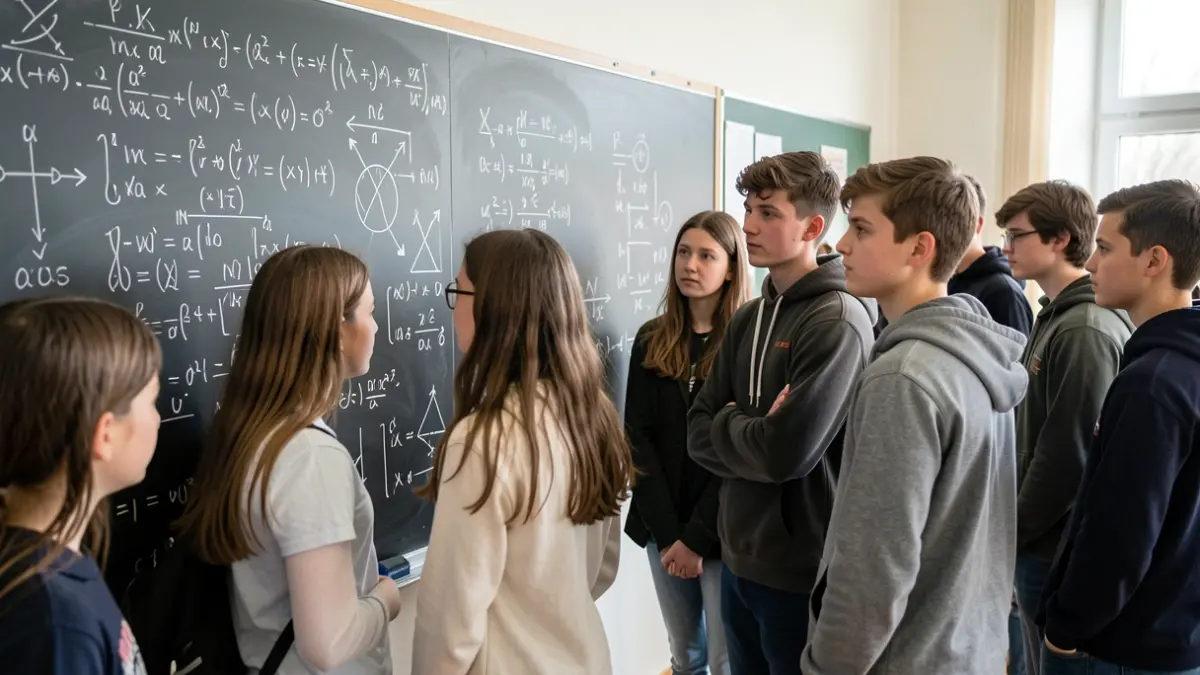
Generic image of a diverse group of young students looking at a blackboard with scientific equations.
A new study from the University of Cambridge has found that the near-complete absence of women scientists in UK exam board specifications for science subjects could be a significant factor in girls dropping STEM subjects at age 16.
The research analysed specifications from the UK’s six main exam boards for science subjects at Key Stage 4 (GCSE level). It revealed that out of 86 scientists mentioned, only one was a woman, Rosalind Franklin, and she featured in just one specification. The study, published in the British Educational Research Journal, highlights that while women made significant contributions to major scientific breakthroughs, these are rarely acknowledged in compulsory learning materials.
Researchers Dr Greg J Cooke, Skyla B White, and Stephanie Buttigieg, in collaboration with the IncludeHer movement, suggest that minor, targeted adjustments to existing teaching frameworks could incorporate the achievements of women scientists, including Nobel Prize winners. They believe this could inspire more girls to pursue STEM subjects, particularly physics and mathematics, at Key Stage 5 (A-level) and beyond.
Despite girls typically outperforming boys in most STEM subjects at KS4, there is a notable gender gap in uptake for physics and mathematics at KS5, with the percentage of girls studying mathematics now lower than in 2005. The study found a "compelling" correlation between the gender representation of scientists students are exposed to at KS4 and their subsequent choices at KS5. Students experience a "saturation" of male scientists in physics learning materials, potentially influencing the lower number of girls continuing with the subject.
The researchers recommend specific inclusions, such as Rosalind Franklin in all biology specifications, Marie Skłodowska-Curie in chemistry discussions on atomic structure, and Lise Meitner as a role model for physics. For KS5 biology, they suggest including the work of Dorothy Hodgkin on protein structures. The study also noted that only three of the 181 scientists mentioned in KS5 specifications were women.
“
"It is important that students understand the iterative history of science and the context behind these discoveries to frame their knowledge when assessing the bigger picture: How did Susan Solomon help save the ozone layer? How did Lise Meitner’s work eventually lead to the dawn of the nuclear age? It is long overdue that we teach these inspiring stories about women."
“
"Despite years of effort to achieve gender parity in science, it is disappointing that students in the UK can complete their science education without learning the names of the women behind the scientific discoveries they study. This matters because it is at this stage, when students begin to choose which subjects to pursue further, that the gender divide grows."
“
"When school science specifications leave out women’s names, they miss a real opportunity to help girls see a future for themselves in science and continue to reinforce the harmful stereotype that science is mainly for men."
The team has developed an app to display the study's data and is conducting a follow-up paper on how teachers incorporate scientists' stories into the classroom. Teachers are invited to participate in a survey to inform this research.